
Sandy Court Docket Searches
Match the court first. The name on your citation, notice, or pleading tells you where the Sandy court docket lives. The Sandy Justice Court page is the local starting point. For case histories across District and Justice Courts, Utah Courts Xchange is the paid public search. The statewide calendar answers only the narrower question of when a hearing is set. MyCase is free. But it serves a party viewing that party's own linked cases and papers.
Gather the filed name, the case or citation number, an approximate date, and the Sandy court location before you begin. Numbers are not unique statewide. So the location filter matters. If the electronic record stops short of a public document, ask the Sandy clerk. Ask whether inspection or a written copy request is available.
- Read the notice and confirm that it names Sandy Justice Court.
- Search Utah Courts Xchange by case number, citation number, or filed name.
- Narrow the scope to Justice Court and the Sandy location.
- Check the statewide calendar for the current date, time, judge, and setting.
- Use MyCase for your own linked file or contact the clerk when the public result is unclear.
Sandy Court FAQ Routes
Sandy sorts its local procedure by the problem a court user actually faces. The FAQ walks through what follows a citation. It also covers traffic plea-in-abeyance and deferred prosecution, small claims, animal citations, notices to appear, Webex, motions, MyCase, interpreters, missed dates, observing court, and appeals. Treat it as a routing aid, not a substitute. Do not rely on it over the official case history or the judge's order. The official Sandy FAQ page shows those topic headings as court users will find them.
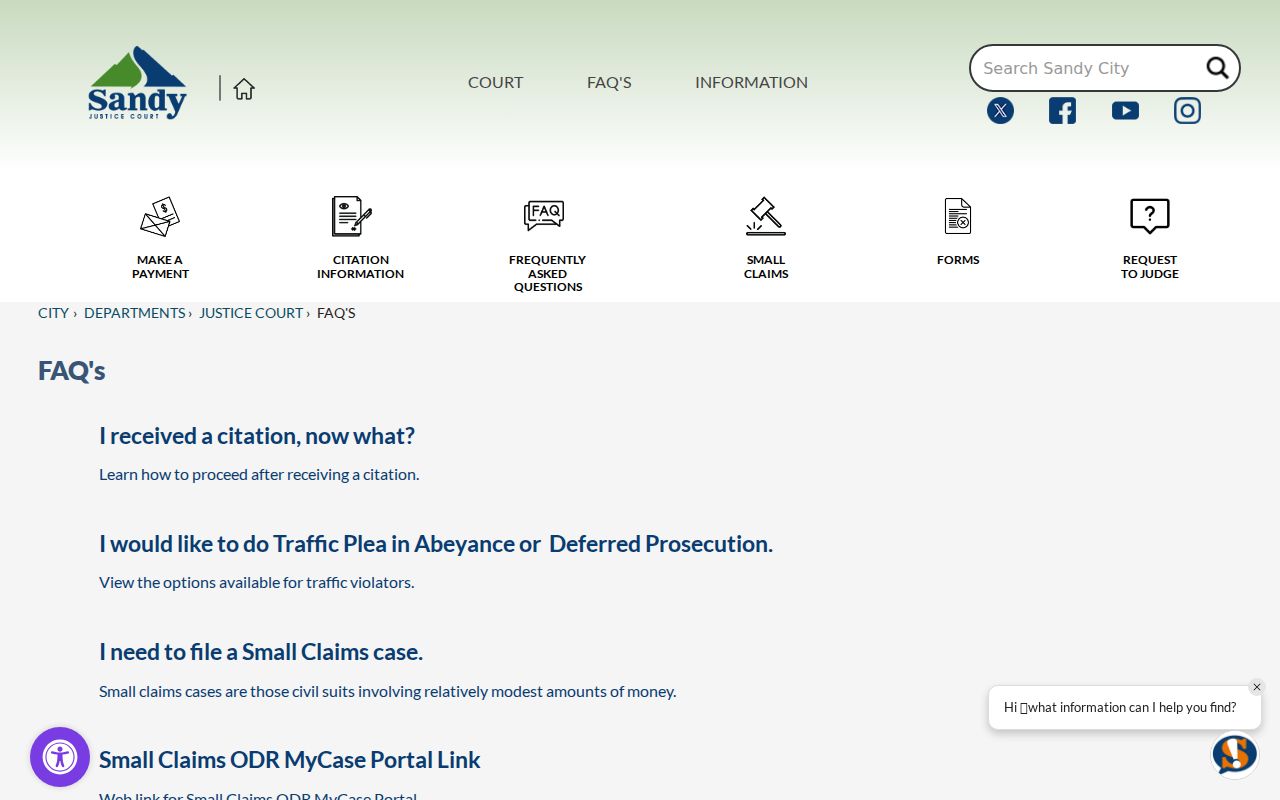
Those categories help a searcher pick the right local follow-up after locating a Sandy court record. Always check the FAQ answer against the current citation, notice, and case history.
Inside the Sandy Municipal Court
Sandy Justice Court is a limited-jurisdiction municipal court inside Utah's Justice Court structure. You will find it at 210 W Sego Lily Drive, Sandy, UT 84070. The published phone is 801-568-7160, and the fax is 801-568-6065. Directory material lists weekday service from 8 a.m. to 5 p.m. Confirm current email and document-delivery instructions before sending anything sensitive.
The docket here covers city traffic and infractions. It also handles most Class B and C misdemeanors within its jurisdiction, ordinance and animal matters, and eligible small claims. Felonies, Class A misdemeanors, major civil suits, domestic cases, and probate matters stay elsewhere. That holds no matter where the events happened in Sandy. The official Sandy court page shows the municipal Justice Court navigation.
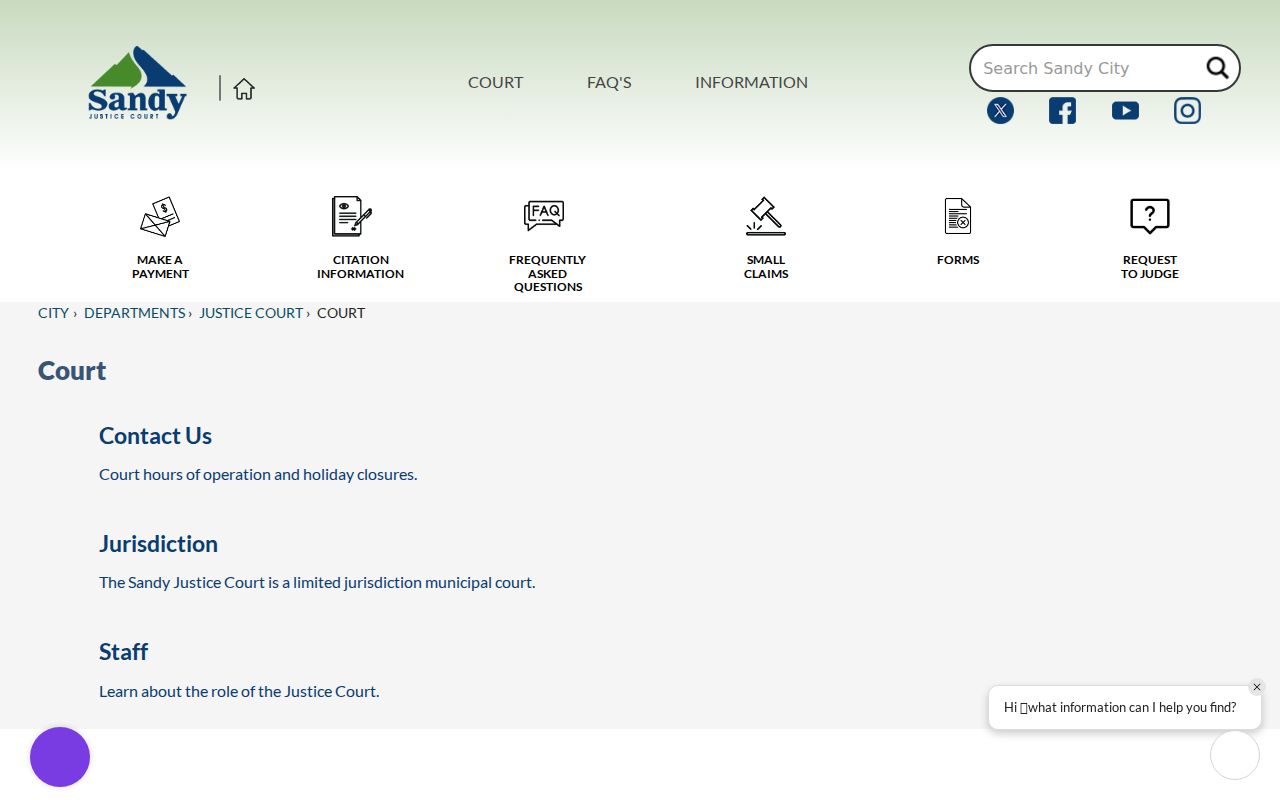
The navigation confirms the split: local procedure belongs with Sandy, while the Utah judiciary supplies the statewide case-history and calendar tools.
Sandy Court Records by Channel
No single channel answers every Sandy records question. Xchange serves a public researcher who needs a statewide or court-specific case history. MyCase, by contrast, serves a party. It gives free access to that party's own papers, payments, linked cases, or notices. The calendar lists scheduled events. A courthouse terminal may offer free CORIS or Xchange access. That depends on the location's availability and document rules.
| Sandy need | Best channel | What it provides |
|---|---|---|
| Public history | Xchange | Paid name, number, citation, and location search |
| Own case | MyCase | Party papers, payments, and notices |
| Next hearing | Utah calendar | A current setting, not the full record |
| Document or copy | Sandy clerk | Counter, phone routing, or written request |
| Local procedure | Sandy FAQ | Webex, traffic, motions, and appeal guidance |
Mail, fax, and email each follow their own forms. Call first when a filing deadline or a sensitive attachment is involved. Staff can explain routing and public availability, though they do not give legal advice.
Finding Sandy Court Dates
The statewide Utah calendar can be searched several ways. Case number, party, judge, attorney, date, and location all work. Choose Sandy and the correct court type. Results may include the date, time, a virtual-hearing marker, location, judge, setting type, case number, and case type. Utah Courts says calendars update on weekdays at about 5:30 a.m. Later changes are still possible.
| Date | The hearing day currently posted for the Sandy case. |
|---|---|
| Time | The listed call or individual setting time. |
| Mode or place | The courtroom or stated Webex arrangement. |
| Judge | The judicial officer assigned to the setting. |
| Setting type | Arraignment, pretrial, review, evidentiary hearing, trial, or another event. |
A setting is not a conviction, a dismissal, or any final result. Check close to the hearing. If a mailed notice conflicts with the calendar, call the clerk instead of guessing which source wins.
Sandy Webex and Court Access
Sandy's FAQ supplies local routes. It covers Webex participation, observing a hearing, interpreter help, and a missed court date. A remote link applies to the named proceeding only. It does not open every Sandy docket to remote attendance. Nor does it authorize recording or redistribution.
UCJA Rule 4-401.02 limits recording, photography, and transmission of court proceedings without authorization. Follow the judge's access directions, and join with the name the court requests. Raise interpreter needs through the official Sandy process as early as possible. A person who missed a setting should contact the clerk promptly. Read the later case history for any order, warrant, reset, or other entry. Silence on an older calendar does not show the matter disappeared.
Sandy Traffic Ticket Lookups
A ticket written into Sandy Justice Court should identify the issuing court or location. Look for the citation number too. The ticket should also state the response deadline and the choices available. Search Xchange with the citation number and Sandy location. Consult the calendar for a setting. Then use the Sandy FAQ for the current PIA or deferred-prosecution path. Never import another city's traffic-school terms into a Sandy case.
Payment and contesting are different procedural choices. Paying may create a court disposition and may carry reporting consequences. Read the exact citation and current Sandy instructions before acting. For the broader picture, see Salt Lake County traffic court records.
Sandy citation check: A blank online result does not move the printed deadline. Confirm posting and court location directly when the due date is near.
Sandy Court Payment Plans
The form asks for more than a balance. Expect to give your name, contact details, date of birth, case number, the amount owed, your proposed payment amount and dates, the payment method, and a signature. That list explains why the clerk wants the exact Sandy case number before discussing any arrangement. Never copy a filled form with real personal data into a public example.
Payments travel three routes. The instructions accept in-person and mail delivery, with check or money order, plus online ePayments. Phone payments are not accepted. Verify the payee, address, and online route first. Paying under a plan does not erase the docket entry, and some consequences may continue on their own schedule.
Read the form's warnings closely. Overdue debt can accrue interest and may become a civil judgment or go to the Office of State Collection after more than sixty days. Willful nonpayment carries contempt risk, and a license can be affected too. These are warnings, not a forecast. Call the court when your circumstances change.
How Sandy Cases Reach the County
A Sandy Justice Court case stays a Sandy court record. It does not move to District Court just because Utah Xchange can display records from both levels. Felonies, Class A misdemeanors, and major civil, domestic, and probate matters begin on the Third District Court route instead. Not everything qualifies. An appeal from Justice Court becomes a distinct District Court trial-de-novo matter under Utah Rule of Criminal Procedure 38. It generally follows timely notice. So match the court to the case type.
Docket flow: Sandy Justice Court › Third District Court › Utah Court of Appeals
Move up a level only when the case type fits. The Salt Lake County court docket overview maps county, city, district, juvenile, and federal routes in more depth. Juvenile and federal records follow separate rules.
Sandy Small Claims Records
The Sandy FAQ covers small claims too. It gives city residents a local guide for filing and procedure. A small-claims docket can list the parties, filing date, the claim, service events, hearings, judgment, satisfaction, and appeal activity where those items are public. One caution. The case history is not the same as every paper in the file.
Before filing, confirm Sandy Justice Court is the right venue. Also check the current statewide limit and fee page. For an existing case, search by case number and Sandy location, then ask the holding clerk for any document not offered online. Certified copies carry clerk authentication. A plain downloaded history does not. Private contact and financial details may be withheld even when the case itself is public.
Sandy Court Docket Context
Sandy ranks fourth among Salt Lake County's incorporated cities. The official 2020 Census table lists 96,904 residents. That number counts people, not Sandy Justice Court filings. Docket volume also reflects Sandy police practices, Sandy jurisdiction, case transfers, and yearly trends. And a calendar count misleads too. One Sandy case can carry several settings.
For a current location-level count, use the Utah judiciary's public data dashboard. It filters filings by court type, judicial district, county, location, case type, and fiscal-year trend back to 2010. Keep the filters and retrieval date with any figure. Do not merge Sandy Justice Court with Third District Court. Never treat pending inventory as annual filings. Population explains why Sandy gets a city page, but a personal court-record search still turns on the case identifier and correct location.
Each metric answers a different question. Filings count new Sandy matters in a fiscal year. Pending inventory counts open matters at one point in time. A calendar counts settings, and one case may appear more than once. Dispositions count recorded outcomes, not new filings, and none of these values can stand in for another. A careful citation names the Sandy court, the metric, the fiscal year, the filters, and the retrieval date. That context keeps a broad statistic from being mistaken for a result in one person's Sandy case.
Who Can See Sandy Court Records
Utah court records follow judiciary rules first. The administrative-record law that covers ordinary city departments is not the main framework here. UCJA Rule 4-202.02 starts from public availability. Rule 4-202.04 sends public requests to the clerk in writing, and it sorts material into private, protected, sealed, and restricted classes that require a valid entitlement or court process.
Sandy access boundary: Public access does not expose sealed or expunged files, ordinary juvenile material, protected domestic records, or private personal identifiers.
Put the request in writing. It should name Sandy Justice Court, the case number or caption, and a date range. It should also state the exact document. Say whether you seek inspection or a copy. Public options extend further. Xchange, the calendar, a courthouse terminal, and MyCase for your own case all provide access. A no-result screen can mean a wrong filter, delayed entry, older data, or a lawful restriction, not proof that no case event exists.