
Salt Lake County Court Record Requests
Find the case first. Search Utah Courts Xchange or ask the court clerk. Xchange sells public District and Justice Court case history and some electronic documents. A party can use MyCase free. But only for that party's own linked history and papers. Free public CORIS/Xchange terminals sit at most District Court locations. Some Justice Courts or the State Law Library may offer them too.
- Identify the court and location from the case history, notice, citation, or caption.
- Inspect the public history and note the case number, document title, date, and public-availability flag.
- Ask the holding clerk about counter, phone, mail, email, fax, or local form channels.
- Use the Utah written court-record process when the paper is not online.
- Choose inspection, an ordinary copy, certification, exemplification, audio, or another supported form.
Federal cases are different. PACER handles those, not Utah systems. County and city administrative files may fall under GRAMA, though GRAMA cannot replace the judiciary request rules.
Salt Lake County Record Custodians
Utah divides custody by court level. The Third District Court clerk holds felony, Class A misdemeanor, major civil, domestic, and probate files. Salt Lake County Justice Court keeps the lower criminal, traffic, infraction, and small-claims cases. Every municipal Justice Court maintains its own city matters. Juvenile Court holds juvenile files under stricter limits.
| Case path | Likely custodian | Routing clue |
|---|---|---|
| District civil or criminal | Third District Court clerk | Matheson or West Jordan District Court location |
| County lower-level matter | Salt Lake County Justice Court clerk | County or unincorporated-area jurisdiction |
| City citation or small claim | Named city Justice Court clerk | Municipal court on the notice |
| Juvenile matter | Juvenile Court clerk | Restricted access rules apply |
South Jordan shut its Justice Court on July 1, 2026. Everything moved to Salt Lake County Justice Court. Keep the old city case or citation number handy when you contact the county clerk about those files. The Matheson Courthouse general line is 801-238-7300. Published division routing lists civil and domestic at 801-238-7480, probate at 801-238-7164, criminal at 801-238-7321, and protective orders at 801-238-7172. Salt Lake County Justice Court uses 385-468-8200, jcsaltlakeco@utcourts.gov, and fax 385-468-8223 instead. Its office sits at 2001 S State Street, Suite S4-300, Salt Lake City. It is open weekdays from 8 a.m. to 5 p.m. with a noon-to-1 p.m. closure. Confirm the right division before you mail anything.
Kinds of Court Records
A docket, called case history in Xchange, is just the index layer. The record behind it can hold pleadings, motions, orders, judgments, public minute entries, exhibits governed by access rules, transcripts, recordings, notices, or account material. No file contains every type. A public case still keeps some documents closed. District Court electronic documents form the main modern Xchange document layer. These are documents filed since July 1, 2010. Older coverage varies with CORIS conversion and each court's own history. A document title with no image attached is not proof it was never filed. Ask the custodian for inspection or a copy instead.
Salt Lake County Request Form Checklist
Utah's official Request for Record form wants the receiving court and a reasonably specific description. It separates inspection from copies. Fee-waiver and nonpublic-entitlement choices are built in, with support. A strong request names the court, case number or caption, date range, document or event, and format wanted.
- Identify the receiving court and clerk.
- Describe the record with dates and a case number when known.
- Choose inspection or copies.
- State a supported fee-waiver basis only if it applies.
- Explain legal entitlement when requesting nonpublic material.
- Provide contact details, date, and signature.
A nonpublic request may need a motion, petition, court order, or other authority. The form cannot unlock what Utah law withholds. Clerk answers often go beyond yes or no. A record may be public but not electronic, held by a different court, or only partly public, and copying may need a fee estimate first. Narrowing the request after an initial inspection usually saves time and money. Unsure which court? Check the Utah Courts directory or the Salt Lake County court-locations page before sending the form.
Court Records: What They Contain
Salt Lake County court case records differ by type. Xchange can reveal the public shell before you pay for anything. Use that shell to pick the exact item. One order may be all you need, not the entire file.
| Identity | Court, location, case number, case type, caption, and filing date. |
|---|---|
| Participants | Public party roles and attorney of record. |
| Chronology | Filings, proceedings, hearings, due dates, judgments, and dispositions. |
| Documents | Titles, dates, and a public-availability indicator where supplied. |
| Case-specific detail | Claims, charges, pleas, orders, or account entries where public and relevant. |
| Access status | Public, private, protected, sealed, restricted, or unavailable electronically. |
A charge is not a conviction. A hearing entry is not an outcome. Read the complete history plus the signed order or judgment before describing what happened.
Free Salt Lake County Terminal Access
Remote Xchange costs money. Utah Courts supplies free public terminal access at most District Court locations instead. A terminal lets you identify documents before paying for copies. Ask the clerk about availability, printing, and whether a record can be inspected on screen. The CORIS public-access page spells out this free route. Free access has a catch. Terminals are walk-up only, so plan a visit during courthouse hours.
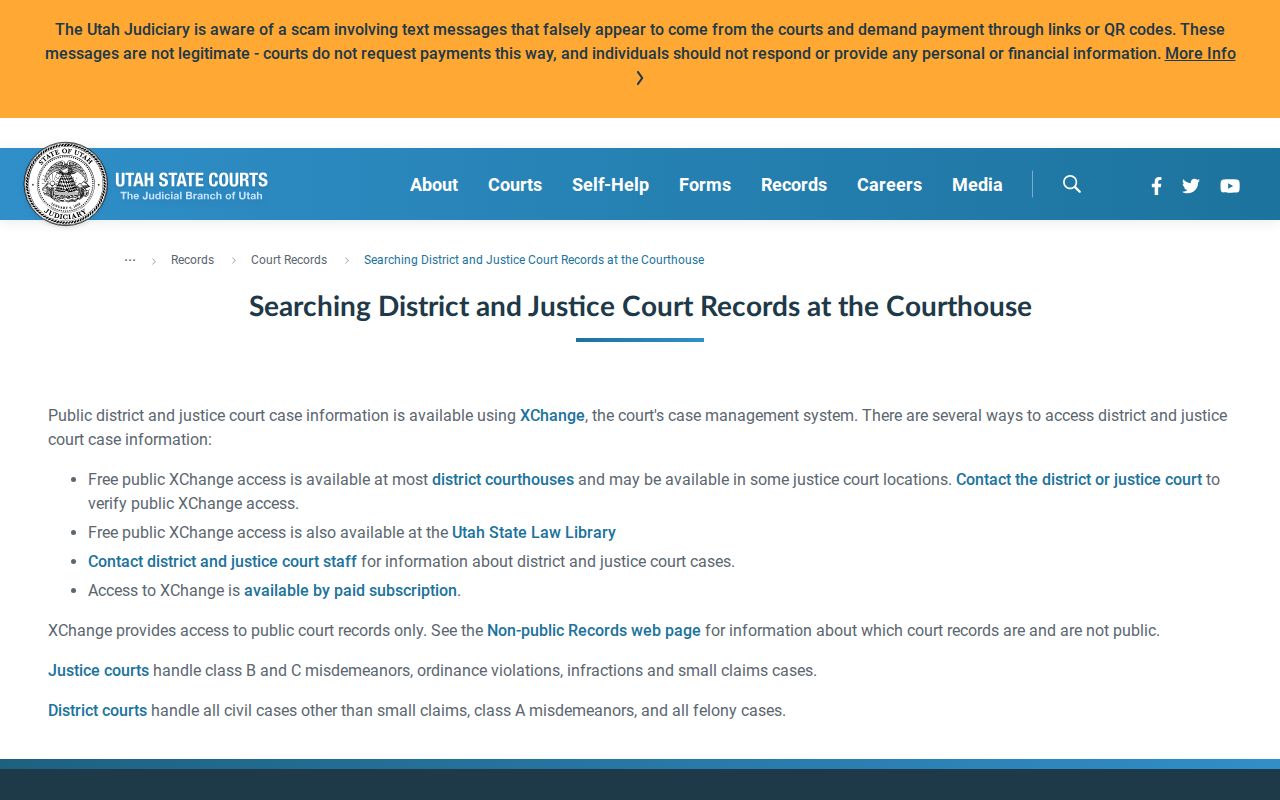
The free terminal shines when an older item or a long history needs review. Copy, certification, and document charges can still apply after inspection.
Copy Fees and Certification
Copy form matters. An ordinary copy just reproduces the public paper. A certified copy carries the clerk's authentication; an exemplified copy carries a higher form. Transcripts, audio, and data exports follow their own rules and prices.
| Item | Researched statewide amount |
|---|---|
| Xchange public document | $1 per available document |
| Certified copy | $4 per document plus $0.50 per page |
| Exemplified copy | $6 per document plus $0.50 per page |
| Inspection | No copy fee on the state request form |
The Utah judiciary fee page shows certification and related charges.
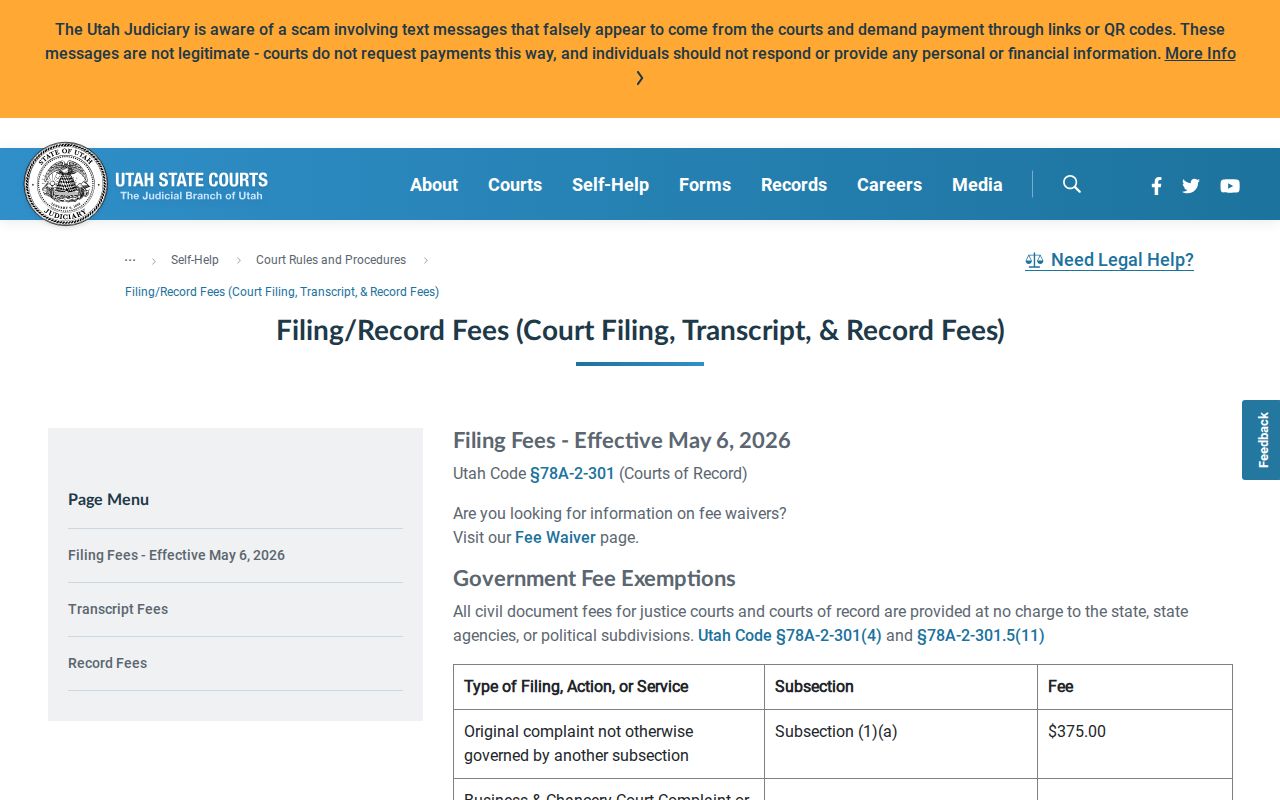
West Valley's local form lists $15 for electronic audio, with a typical one-to-three-business-day process. Local terms vary by court, so verify current amounts before ordering.
West Valley Record Request Detail
West Valley City handles its own record requests with a local form. It collects your contact information, a description of the record, the case number, and defendant identification. You also pick view or copy, the record type, your entitlement basis, and whether you want certification. Supporting documents can be uploaded along with the request. One limit stands out: the form states that Xchange or MyCase records are not sent by fax or email.
The West Valley Court Records Request page shows the form and its fields as the city publishes them.
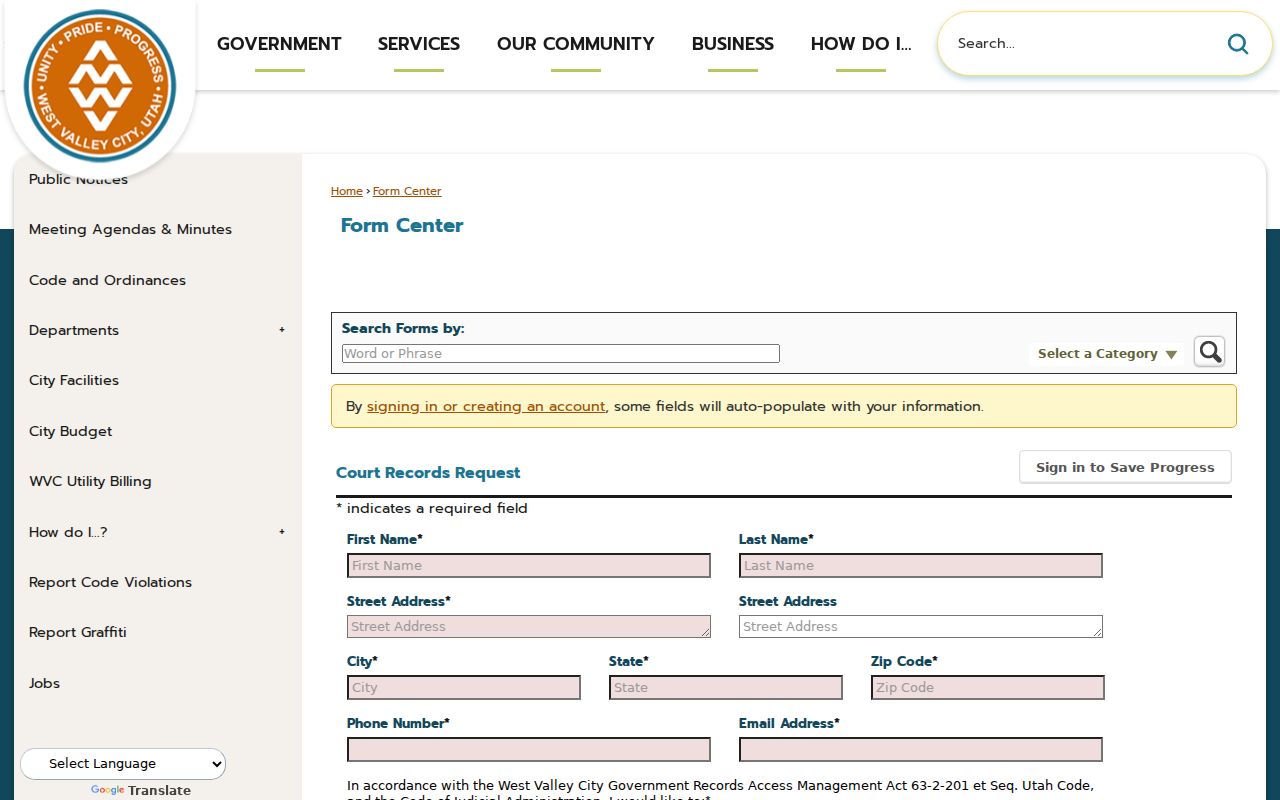
This form covers West Valley Justice Court records only. It does not reach Third District Court or every Salt Lake County court, so send each request to the office that actually holds the file.
Access Rules for Court Records
UCJA Rule 4-202.02 sets the default for court records in Salt Lake County: everything is public unless a rule, statute, court order, or protected category says otherwise. Three companion rules fill in the details. Rule 4-202.03 spells out who may view public and private material, while Rule 4-202.04 governs written requests and the procedure for reaching nonpublic records. Rule 4-205 adds restrictions on sealed and expunged entries in court computers and indexes. The official rule page lays out the full framework of public, private, protected, sealed, and restricted categories.
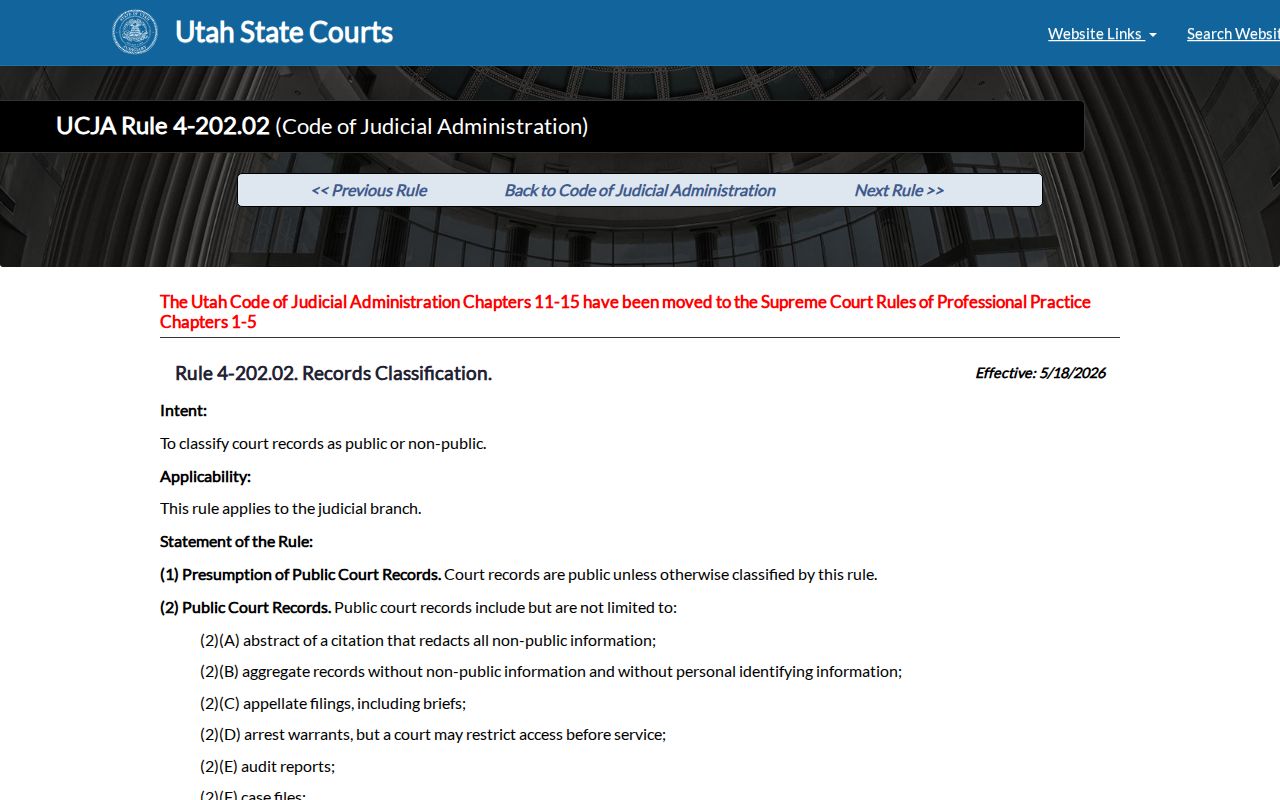
Not every part of a docket entry is open. Juvenile, domestic, guardianship, protective-order, and personal-identifier material can stay limited even when some case-history entries are public.
Access depends on the record. “Not public,” “not electronically available,” “sealed,” and “not held by this court” are different results.
A clerk can route a request but cannot grant access beyond a rule or order.
Salt Lake County Filing and Redaction
Filing in Salt Lake County district court runs through Utah Courts District Court eFiling. That system is for filers, not searchers. It takes an account plus an electronic filing service provider, and none of that doubles as a public records search. When documents later go public, they surface through Xchange. Parties to a case pull their own papers through their own case access, and an eFiling login never opens someone else's file.
Redaction falls on the filer. So does picking the right document type. A clerk may catch some privacy slips, but not every one, before a filing reaches public view. Treat the docket carefully: never republish private names, birth dates, addresses, victim data, account numbers, or protected juvenile and domestic material from a court record.
Missing something from a public file? Ask in writing, and be specific. Records marked private, sealed, or restricted take a formal entitlement showing or a motion, not a friendly phone call and not a public search account. Those access controls stand no matter how the request arrives.
A few eFiling rules explain odd gaps in a case history. Searchable PDFs are expected where appropriate. The filer keeps the original. Proposed orders may need an editable format. That is why a Salt Lake County court docket can list a filing while the public image stays out of reach, since the public path remains Xchange, terminal inspection, or a clerk request.