
Salt Lake County Court Docket Searches
For Salt Lake County case history, start with Utah Courts Xchange. It is the paid statewide search covering District and Justice Court records. Pick District Court, Justice Court, or both. Then narrow the scope to Salt Lake County or a single known court. You can search by case number or by a name as it was filed. When the results pile up, add filters to cut the noise. Try a case type, filing or disposition dates, birth date where allowed, citation number, or citation location.
One caution: case numbers and citations are not unique statewide. Always keep the court name next to the number. Xchange caps any search at 500 results. A broad name search may force you back to the filters. For a business, use the last-name or company field. The official help suggests a surname plus the first letters of a given name followed by an asterisk. That trick helps when a name is common.
- Identify the likely court level and location.
- Open Xchange and choose the correct jurisdiction.
- Enter a case number, citation, or name as filed.
- Narrow by Salt Lake County, case type, court, or date.
- Open the case history and note which papers are public.
- Use the holding clerk when the public paper is not online.
Salt Lake County Xchange Search Fields
The Xchange help page walks through every control and what each result line means. Jurisdiction separates District from Justice Court. Search Type can pull all cases or judgments. Search Scope can be statewide, countywide, or one court. An expanded panel filters by case filing, case disposition, judgment, and judgment disposition dates. These settings matter a lot in Salt Lake County, where state, county, and city courts all run at the same time.
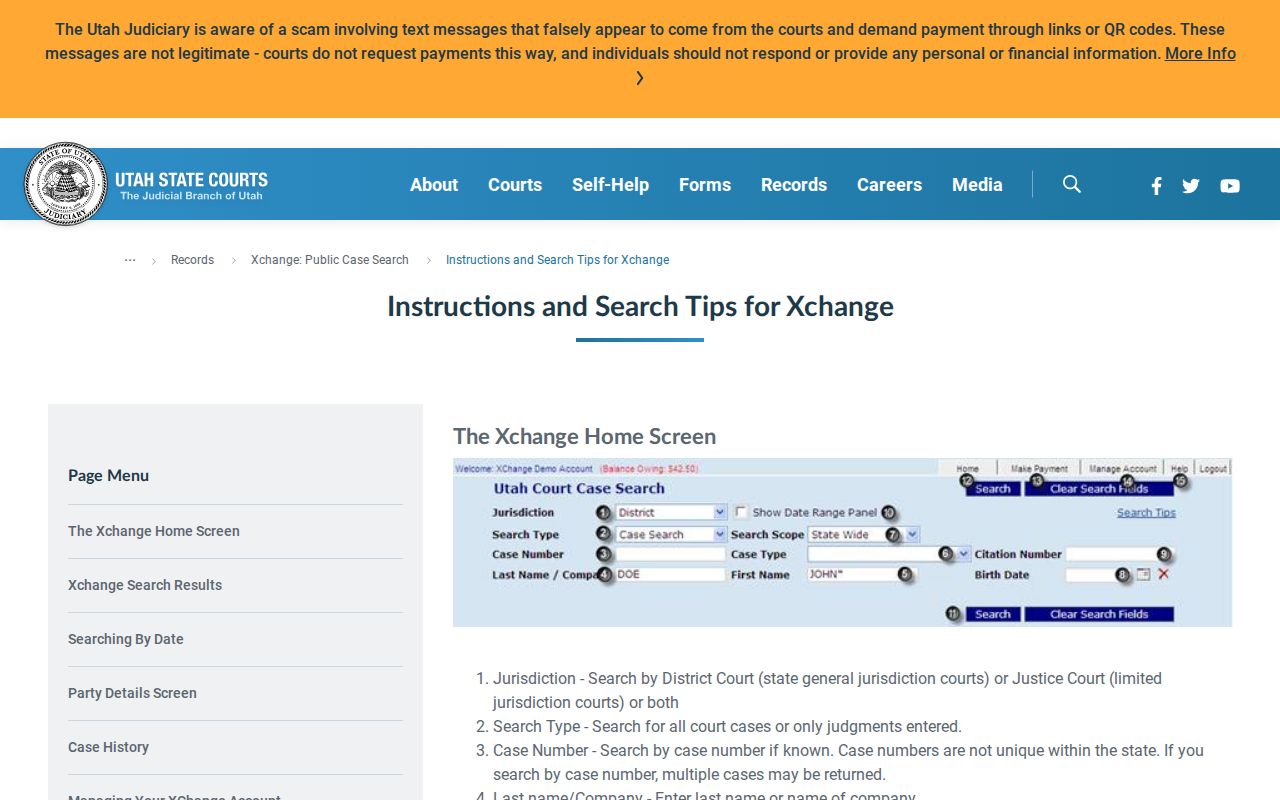
The screen shows why a Salt Lake County court docket search works best when you pick the court, case type, and dates first, instead of trusting a name alone.
| Field | Use | Salt Lake County tip |
|---|---|---|
| Jurisdiction | District, Justice, or both | Match the offense or civil claim to court level |
| Case number | Direct identifier | Add court because numbers are not statewide unique |
| Name or company | Party search | Enter the spelling used in the file |
| Scope | State, county, or court | Narrow to Salt Lake County when appropriate |
| Case type and dates | Reduce results | Separate criminal, civil, traffic, probate, or small claims |
Court Dockets: What They Show
Online, a Salt Lake County court docket appears as a case history. It can list the county, court location, case type, filing date, case number, caption, party codes, attorneys, judge, proceedings, documents, judgments, dispositions, and balances. The exact fields depend on the matter. Criminal docket histories add more. They may also show charges, pleas, citation data, the prosecuting agency, and violation dates. Calendar results add time, appearance mode, judge, setting type, and court location. Privacy rules can hide fields in domestic, probate, juvenile, and protected matters.
| Case identity | Court, location, case type, filing date, and case number such as 26XXXXXXXX |
|---|---|
| People and roles | Caption, party code, counsel, and judge where public |
| Case activity | Filings, proceedings, settings, continuances, and orders |
| Outcome fields | Judgment, disposition, satisfaction, dismissal, transfer, or appeal entries |
| Document layer | Title, date, and indicator of whether a public document can be obtained online |
Remember that the case history is an index, not always the full court file. A document title does not replace the paper itself. A charge is not proof of guilt, and a listed hearing is not proof of any outcome.
Salt Lake County Xchange Entry
The Xchange landing screen offers guest access, account setup, login, payment, and help links. Guest access suits a one-time public inquiry. An account makes sense for repeated docket research. Both routes reach public case information only. Sealed, expunged, or ordinary juvenile material stays off limits. JavaScript must be enabled for the live service to run.
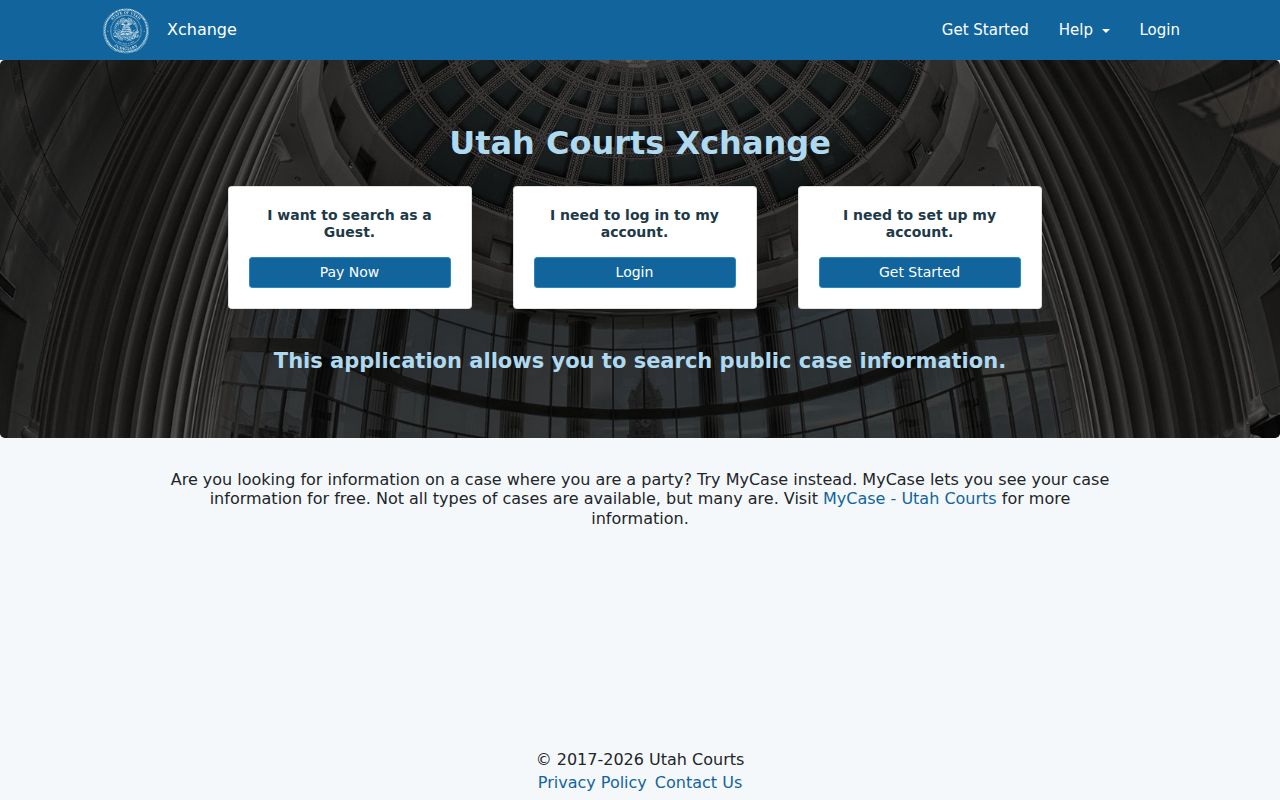
The two entry routes split a temporary guest session from a registered account. Neither one turns Xchange into an e-filing system or a party identity portal.
MyCase is the free route for a party. A party can see that party's linked history and filed papers, pay eligible fines or fees, receive notices, and link cases. District Court eFiling handles authorized electronic filing. The calendar covers scheduled events. Matching the tool to the task avoids needless fees and missed records.
Salt Lake County Courts and Their Dockets
Utah does not park every Salt Lake County court docket with one county clerk. Third District Court clerks maintain felony cases, specified Class A misdemeanor cases, general civil, domestic, probate, and other District Court records. The Salt Lake County Justice Court clerk keeps the cases filed in that county court. Each municipal Justice Court clerk holds that city's lower criminal, traffic, infraction, and small-claims matters. Juvenile Court keeps its own restricted records.
| Court | Docket covers | Where to search |
|---|---|---|
| Third District Court | Felony, major civil, domestic, probate | Xchange, MyCase for parties, Matheson or West Jordan clerk |
| County Justice Court | Covered-area traffic, infractions, lower misdemeanors, small claims | Xchange, county clerk, calendar, terminal if offered |
| City Justice Court | City cases within limited jurisdiction | Xchange plus the city's court page and clerk |
| Juvenile Court | Delinquency, child welfare, related matters | Restricted court process |
| Federal courts | Federal civil, criminal, and bankruptcy | PACER and the federal clerk |
A Justice Court appeal opens a District Court trial-de-novo path. Trial de novo means a fresh trial at District Court, not a simple review of the Justice Court docket.
Salt Lake County Court Location Check
The main Salt Lake City District Court site is the Matheson Courthouse. The address is 450 S State Street, Salt Lake City, UT 84114-1860, phone 801-238-7300. Salt Lake County Justice Court sits at 2001 S State Street, Suite S4-300, phone 385-468-8200. Salt Lake City Justice Court is in the John L. Baxter Courthouse, 333 S 200 E, phone 801-535-6300. West Jordan has separate District and Justice Court addresses of its own.
Check the county court directory or the Utah judiciary directory. Either one can confirm which clerk holds the file, plus hours and submission steps. Don't send a city case request to Matheson. Don't send a District Court paper request to the county Justice Court. Both offices share Salt Lake County, and that is the only thing they share.
Current routing change: South Jordan Justice Court closed on July 1, 2026. Its transferred and new court matters now route to Salt Lake County Justice Court. Keep an old citation or case number when contacting the county clerk.
Court Dates and Settings in Salt Lake County
The Utah Courts calendar search is separate from Xchange. It searches by case, party, judge, attorney, date, and location. A result can show date, time, virtual-hearing status, court location, court type, judge, and setting type. Case number and case type appear too. Salt Lake City also posts a daily calendar. It reaches 30 days ahead and is searchable with the browser's find command.
Check again close to the scheduled time. Continuances, resets, cancellations, courtroom changes, and remote links can all move a setting. The Utah judiciary updates its calendars on weekdays around 5:30 a.m. A calendar entry records a planned event, never a ruling, plea, judgment, or conviction. Want what actually happened? The Salt Lake County case history or a signed order is the better court record.
A setting that conflicts with a notice needs a phone call. Call the court named in the case. Staff can confirm location and access steps. They cannot advise what a party should argue or file.
Salt Lake County Access Channels
A dead end in one channel is rarely a dead end. A Salt Lake County court docket search can move through several doors. Each answers a different question. Remote Xchange covers broad public lookup. MyCase works for parties to a case. The calendar settles hearing dates. Free public terminals running CORIS or Xchange sit at most District Court locations. Some Justice Courts may offer them too. So may the State Law Library. When screens fail, the clerk's counter or phone can still confirm custody and public status.
Written requests go through the Utah Judiciary to the clerk holding the file. Name the court. Give the case number or caption, the date range, the exact paper wanted, and whether you seek inspection or copies. The Salt Lake County Justice Court publishes email and fax numbers. City courts in the county vary, accepting mail, vendor payment, email, fax, or another method tied to their own form. Check the current local page so your request does not land at an old counter.
Federal cases live in PACER. County or city agency files outside a court case fall under GRAMA. Those routes run alongside the Salt Lake County court docket. They never replace the clerk who owns it.
Docket Access Under Utah Law
Utah judiciary rules control access. Salt Lake County court records follow them. A public case history can still hold private, protected, sealed, or restricted papers inside it. Utah's Government Records Access and Management Act is GRAMA. It does not automatically govern court access. That statute generally reaches county and city administrative records instead. For a court file, follow the court rules. Ask the holding clerk.
UCJA Rule 4-202.02 classifies public, private, protected, sealed, and restricted court records.
UCJA Rule 4-202.03 explains who may inspect public and nonpublic records.
UCJA Rule 4-202.04 directs written requests to the clerk and governs nonpublic access paths.
UCJA Rule 4-202.08 addresses copy, certification, transcript, recording, and data fees.
Juvenile, expunged, and sealed records carry extra limits. Public access never licenses careless spread of birth dates, home addresses, victim data, account numbers, or sensitive family details.
Salt Lake County Guest Search Costs
Xchange charges fees once you leave a courthouse terminal. The official subscription page lists a guest or one-time search at $0.35, and the live registration screen shows $0.20 for one-time searches with a $10 deposit available for searches and documents. Documents are listed at $1. Confirm the actual figure at live checkout before you pay.
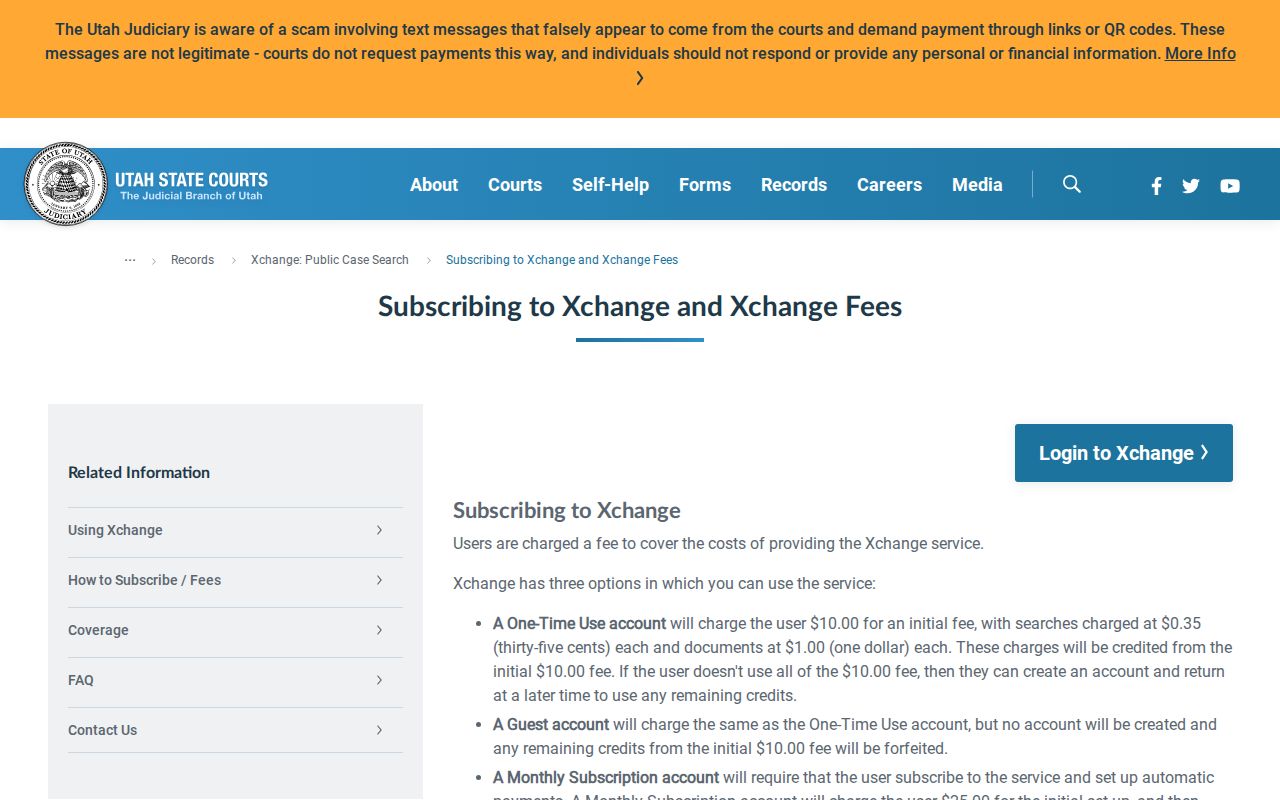
Published fees give a reference, but the live price controls what you actually pay. Monthly access is published as a $25 setup fee plus $40 per month. It includes 500 searches. Extra searches are billed separately. Documents cost extra on top of that.
Can you visit? A free courthouse terminal may beat paying online for a Salt Lake County searcher. A clerk inspection request can also dodge copy fees when reading, not owning, is the goal.
How the Clerk Keeps Docket Records
Every Salt Lake County clerk keeps the case history and papers for that court's level. The Third District Court clerk holds the big share. That means state felony, major civil, domestic, and probate records. The Salt Lake County Justice Court clerk keeps the county's limited-jurisdiction docket. Each city Justice Court clerk keeps that city's cases. The Juvenile Court clerk handles juvenile files under tighter rules.
A strong request names the court, the case number or caption, the case type, the date range, and the event or paper you want. Note the form you prefer too. The clerk can explain inspection, ordinary copies, and certification. Ask where to submit. Current statewide guidance sets a certified copy at $4 per document plus $0.50 per page, and an exemplified copy at $6 per document plus $0.50 per page. Audio and transcripts are priced separately.
Salt Lake County Justice Court
2001 S State Street, Suite S4-300
P.O. Box 144575
Salt Lake City, UT 84114
385-468-8200
jcsaltlakeco@utcourts.gov
Fax: 385-468-8223
The county office opens weekdays from 8 a.m. to 5 p.m., closes noon to 1 p.m., and stops payments at 4:30 p.m. Verify current details before travel.
Salt Lake County Xchange Accounts
Guest access and registered Xchange accounts fit different search patterns. The official registration screen asks for an account type and email. A username or guest choice comes next. Verification data, password, payment amount, agreement, and billing fields follow. Guest sessions can run up to 24 hours, though a 30-minute idle limit applies. Any unused funds may vanish when the session expires.
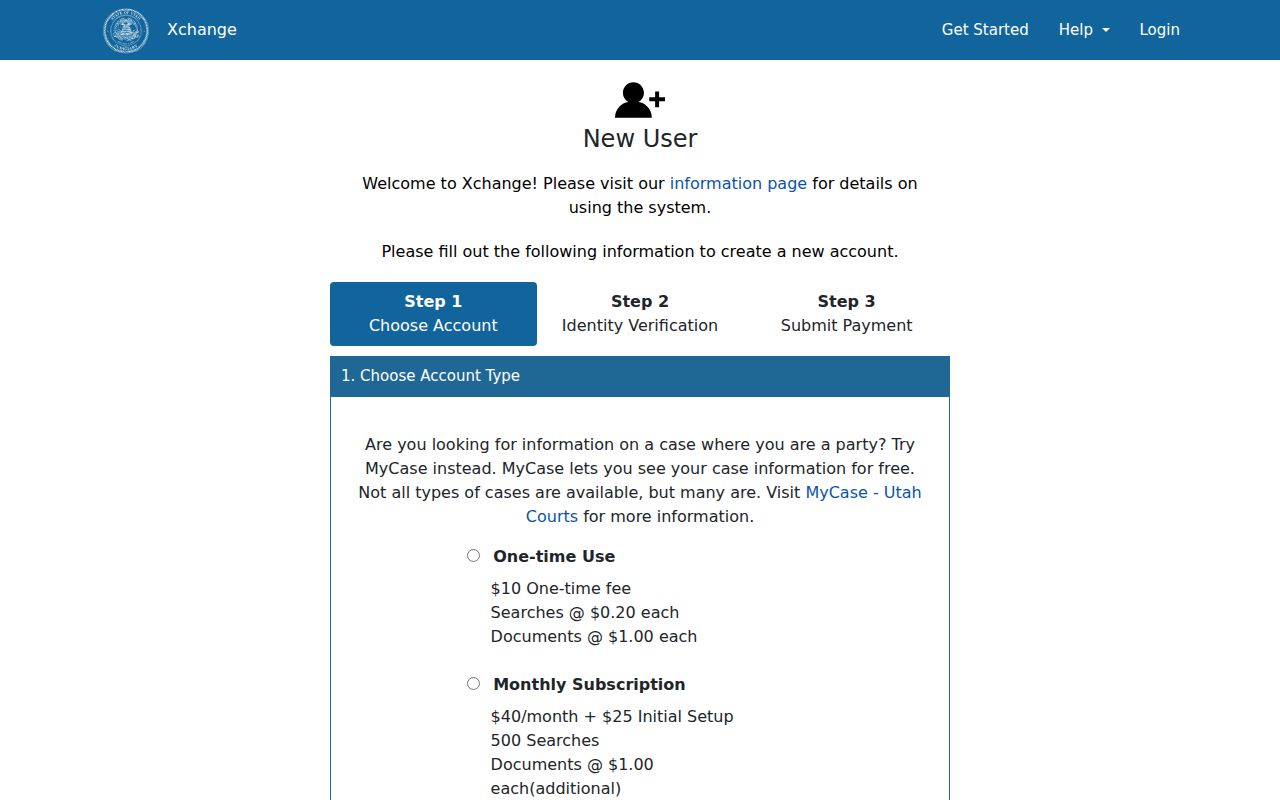
Plan before you open a paid temporary session. Gather Salt Lake County case names, dates, locations, and numbers first. That way the clock and the deposit work for you.
Never ask a party to share MyCase credentials or identity documents. MyCase signup requires an email, a case number, and government identification. That is because it grants direct party access. For public research, Xchange remains the proper tool, subject to its fees and public-access limits.
City-by-City Court Dockets in Salt Lake County
Salt Lake County has five largest incorporated cities by the 2020 Census. Each one has distinct court routes. Population rank says nothing about docket volume. Every city court keeps its own limited-jurisdiction identity, address, and clerk, even when public case history also shows up in statewide Xchange. Let a citation or notice drive your first location check.
Salt Lake City Court Records
John L. Baxter Courthouse Justice Court, with city calendar and payment paths.
West Valley City Court Records
City Justice Court with local payment and records-request forms.
West Jordan Court Records
Justice Court is separate from the nearby West Jordan District Court.
Sandy Court Records
City Justice Court with local traffic, small-claims, and remote-hearing guidance.
South Jordan Court Records
The city court closed July 1, 2026; cases now route to county Justice Court.
Old links and citation forms can linger online after a route changes. Verify the current city or county court page before filing, paying, mailing, or appearing.
Salt Lake County Search Pitfalls
A blank Xchange result is rarely a dead end. The scope might be set to the wrong court or county. The name on file may be spelled differently than the one typed in. Filters can be too narrow. Some older Salt Lake County records simply lack electronic depth. Sealed, expunged, private, protected, restricted, and juvenile cases stay hidden. Federal matters stay hidden too, as do files sitting in a city administrative system.
Write down the terms, filters, and retrieval date before trying again. Then turn to the calendar, the directory, the terminal, or the clerk. Chasing an old South Jordan case? Keep the original identifier. Contact Salt Lake County Justice Court. Federal civil, criminal, and bankruptcy records belong in PACER. They are not found in another round of Xchange filters.
Docket codes need context too. AP or PA can point to payment in lieu of appearance. Dismissal, judgment, transfer, satisfaction, vacation, and expungement codes each carry a precise procedural meaning. A Salt Lake County court docket points you toward the official record. It does not replace an order, and it is not legal advice. Read the full history and the controlling paper before drawing any conclusion.
Map and Directions to the Matheson Courthouse
Third District Court, which holds Salt Lake County's felony, major civil, domestic, and probate case files, sits at the Matheson Courthouse, 450 South State Street, in downtown Salt Lake City. The building has separate division lines for civil/domestic (801-238-7480), probate (801-238-7164), and criminal (801-238-7321) matters. A second Third District location, West Jordan District Court at 8080 South Redwood Road, Suite 1701, serves the southwest part of the county and is a different building and address from West Jordan's own Justice Court.
Matheson Courthouse
450 South State Street
Salt Lake City, UT 84114-1860
801-238-7300
West Jordan District Court
8080 South Redwood Road, Suite 1701
West Jordan, UT 84088
The Matheson Courthouse's underground public garage closed January 1, 2026; the Utah judiciary's current guidance points visitors to nearby surface and private lots, metered street parking, and the adjacent Courthouse TRAX stop instead. Expect security screening at the entrance, and bring the case number or caption since public terminal access still requires knowing which case history to pull.