
Salt Lake County Civil Docket Searches
Utah Courts Xchange is the statewide paid search for District and Justice Court case history. Set the jurisdiction, case type, Salt Lake County scope, and court location first. Then enter a caption, party name, or case number. Companies go in the last-name field. For common names, official help suggests the last name plus the first few letters of the first name with an asterisk after them. Date filters narrow results by filing, disposition, judgment, or judgment disposition.
Xchange alone may not finish the job. MyCase is free for a party's own linked case and papers. Many District Court locations offer a free public terminal. You can also call or visit the clerk who holds the file, inspect it in person, mail a written request, or order copies. The separate calendar confirms a setting. Email and fax options differ by court.
- Decide whether the matter belongs in District Court or small claims in Justice Court.
- Select civil, domestic, probate, or small-claims case type as appropriate.
- Search by case number or the party name as filed.
- Open the matching case history and inspect its document indicators.
- Ask the correct clerk for public documents that are not online.
Salt Lake Civil Court Routes
Civil matters in Salt Lake County mostly run through the Utah District Court. That court takes general civil actions, domestic relations, probate, most evictions, and the bigger claims. Two state locations serve the county: the Matheson Courthouse and the West Jordan District Court. Justice Courts sit below them. These limited courts hear small claims, but only where the local venue is right, and each county or city Justice Court keeps the case docket for cases filed there.
| Matter | Court path | Search focus |
|---|---|---|
| Contract, tort, property, eviction | District Court | Civil type and District location |
| Domestic or probate | District Court | Special case type and access status |
| Small claim | Justice Court | Correct county or city venue |
| Federal civil or bankruptcy | Federal court | PACER, not Xchange |
Salt Lake County has no single civil records desk. Instead, parallel clerks serve the different courts. Check which court name sits on the complaint or notice, and start your docket search there.
Civil Dockets: What They Show
Think of a Salt Lake County civil docket as the index to a case's activity. It can list the case number and type, the filing date, the caption, party roles, counsel, and each proceeding. Document titles with dates show up too. Judgments, dispositions, and whether a public paper can be bought online appear there as well. One caution. Clicking the case-number link expands the history. It does not pull up every document on its own.
| Case identity | Court location, civil type, filing date, and a number such as 26XXXXXXXX |
|---|---|
| Caption and parties | Names as filed and roles such as plaintiff, defendant, petitioner, or respondent |
| Filings | Complaint, answer, motion, notice, affidavit, proposed order, or other titled entry |
| Proceedings | Conference, motion hearing, trial, review, and continued settings |
| Outcome layer | Judgment, order, dismissal, disposition, or appeal activity |
A docket title is not the paper itself. When exact terms matter, read the public order or judgment, and ask the clerk to confirm certified status.
Matheson Civil Docket Desk
Salt Lake City's Matheson Courthouse serves as the main District Court hub for Salt Lake County. One building, many phone lines. Civil and domestic routing runs through 801-238-7480. Probate has its own line at 801-238-7164. Protective orders sit at 801-238-7172, civil mental health at 801-238-7191, and supplemental procedure at 801-238-7433. Before mailing a request to the civil docket desk, figure out which case type you are chasing. That way it lands with the right staff.
Matheson Civil and Domestic Division
450 S State Street
P.O. Box 1860
Salt Lake City, UT 84114-1860
801-238-7480
Before you mail anything or make the trip, confirm the details on the official Matheson directory. One more District Court sits at 8080 S Redwood Road, Suite 1701, in West Jordan. Do not confuse that state District location with the West Jordan Justice Court next door.
What Cases Fill the Civil Docket
Civil dockets in Salt Lake County cover everything from debt disputes to deeply personal matters. District Court takes the heavy lifting: civil actions, domestic cases, probate, guardianship, and other general-jurisdiction work. Small claims go to the Justice Courts instead. Utah's current statewide guidance caps small claims at $20,000, though venue still turns on the defendant, the transaction, or the property tie spelled out in the court rules.
| Civil group | Common docket activity | Access point |
|---|---|---|
| General civil | Pleadings, motions, discovery disputes, hearings, judgment | District case history and clerk |
| Domestic or probate | Petitions, notices, reviews, orders | District clerk with access limits |
| Small claims | Affidavit, service, mediation or ODR, trial, judgment | Correct Justice Court |
West Jordan's own court page demands a city connection before it will host your small-claims filing. Salt Lake City's court, meanwhile, advertises an online dispute-resolution route. Treat each as local flavor rather than a rule for every Salt Lake County Justice Court.
Small Claims Are Separate Dockets
Small claims in Salt Lake County live on the Justice Court docket, not the District Court civil docket. Both may show up in Xchange. Venue decides where the initial claim gets filed. The state's dollar limit and the local filing desk are two separate questions. Check both before you file, pay, or ask for a copy of a record.
An appeal changes the picture. Utah gives the losing side a trial de novo. That means the District Court starts fresh instead of reviewing what the Justice Court already did. The rules allow a 28-day notice period to trigger that path. You now have two distinct records, the Justice Court case history and the new District Court case. So write down both case numbers and both court names.
Two trails can exist. An appeal may leave activity in the original Justice Court history and create a new Salt Lake County District Court record.
Hearings on the Civil Docket
Civil settings in Salt Lake County come in several forms: case-management conferences, motion hearings, evidentiary hearings, trials, reviews, and remote appearances. The official Utah calendar lets you search by case, party, judge, attorney, date, or location, and each result can show the time, the mode, the judge, the setting, and the case type.
A hearing date is only a plan. It tells you nothing about who won. A continuance pushes the setting back, and a cancellation wipes it off the calendar entirely. The judge may rule much later in a written order. After the event, compare the calendar against the case history, then read the public order itself instead of guessing from the hearing label. If a mailed notice shows a different date, call the court right away.
- Motion
- A request asking the court to take a procedural or substantive action.
- Setting
- The scheduled time and type of a court event.
- Continuance
- A court-approved move to a later date.
- Judgment
- The court's formal decision on the claim or stated issues.
From Civil History to Documents
Think of Xchange's case history as a shell, with the papers inside. Utah's online document layer covers public electronic District Court filings from July 1, 2010 onward. Older material and conversion histories vary. A paper may be flagged public and available, yet still not sit online. Xchange help sets the price at $1 per document, whatever the page count.
Sometimes a public paper stays out of reach. The Utah Request for Record form is the tool. Send it to the right clerk and describe the item clearly enough to find. Inspection costs nothing; copies fall under Rule 4-202.08. The form also carries fee-waiver and nonpublic-entitlement options. Some court rules demand a motion or petition rather than a simple request.
District eFiling is separate. It serves authorized filers, not the public. It is not a Salt Lake County docket search. Filed papers reach Xchange later, once access and redaction rules allow.
Who Can See Civil Dockets
Most Salt Lake County civil case histories are public. Open shells still hide papers, though. Domestic matters, protective orders, guardianship, probate, and financial or personal-identifier limits can close individual documents. UCJA Rule 4-202.02 sorts records into public, private, protected, sealed, and restricted classes. Rule 4-202.03 says who may see each class.
Court records answer to judicial access rules and the clerk's process. GRAMA covers many county and city agency records instead. It sits in Utah Code Title 63G, Chapter 2. So a county record and a court pleading can sit with different keepers. Each follows different rules. Route the agency record through GRAMA; route the civil case file through the court request.
Privacy point: Public availability does not justify copying private identifiers. Redact addresses, birth dates, account data, and sensitive family details from examples or screenshots.
Salt Lake Civil Copy Choices
Copies come in several grades. An ordinary copy, a certified copy, an exemplified copy, a transcript, and an audio record each fill a different need. Certification costs more than a plain printout. Statewide guidance lists certification at $4 per document plus $0.50 per page. Exemplification runs $6 per document plus $0.50 per page. Audio, transcripts, data work, and other services follow separate rules, so confirm the live fee with the clerk holding the file. The official Utah court fee page lays out the statewide choices.
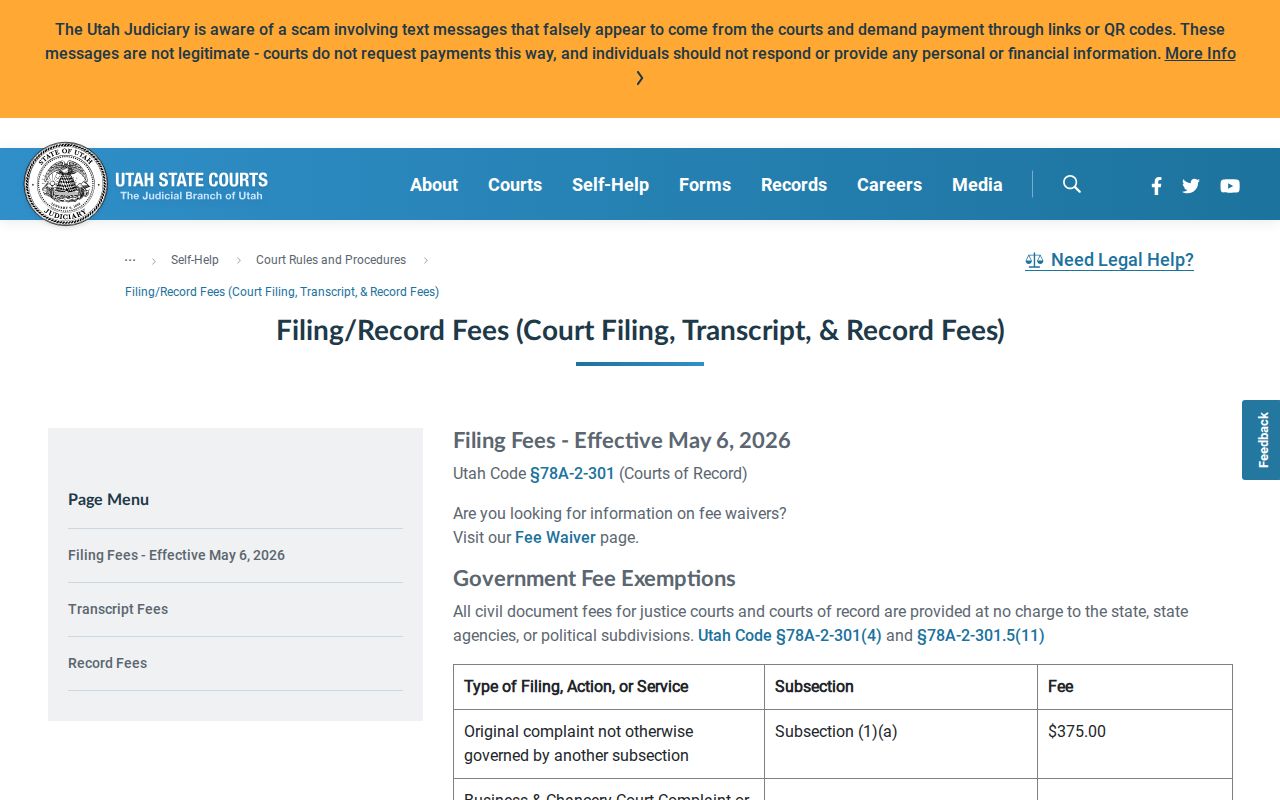
The fee chart draws a clean line between a basic online document and a clerk-certified or exemplified copy. Ask which form your situation requires before paying for the most formal version.
Salt Lake Civil Filing Trends
The Utah Courts data dashboard is the best source. It shows current Salt Lake County filing trends. It filters by court type, district, county, location, case type, and fiscal year. Coverage runs back to 2010. That distinction matters. A pending-case count is not annual filings. The official FY2025 first-quarter report counted 2,025 general civil cases. Those were pending in Salt Lake County Justice Courts on October 2, 2024. District civil cases were not all included. Cases actually filed that year were not the measure.
The Utah court statistics page posts the updated workbooks and methods. A high or low count says nothing about timing in a single case. Court, case type, service, motions, and hearing needs shape each record trail.
Federal civil suits and bankruptcy cases sit outside these totals and outside Xchange. Those go through the U.S. District Court for the District of Utah. The Bankruptcy Court and PACER play their parts too.